
Disunity and Indeterminacy in Artificial Consciousness (and Maybe in Human Consciousness Too)

Our understanding of the nature of consciousness derives mainly from our understanding of the nature of consciousness in our favorite animal (us, of course). But the features of consciousness in our favorite animal might be specific to that animal rather than universal.
Let’s consider two such features and whether we should expect them in conscious AI systems, if conscious AI systems are ever possible.
Unity: Our conscious experiences at any given moment are bound together into a single unified experience, rather than transpiring in separate streams. If I’m sitting on a wet park bench, I might (a.) visually experience the leafy green trees around me, (b.) tactilely experience the cold dampness soaking into my jeans, and (c.) consciously recall the smaller trees of yesteryear. Normally -- perhaps necessarily -- three such experiences would not run in disconnected streams. They would join into a composite experience of (a)-with-(b)-with-(c). I experience not just trees, cold dampness, and a memory of yesteryear, but all three together as a unified bundle.
Determinacy: At any given moment, I am either determinately conscious or determinately nonconscious (as in anesthesia or dreamless sleep). Likewise, I either determinately do, or determinately do not, have any particular experience. Gray-area cases are at least unusual and maybe impossible. Even the simplest, barest cases are still determinate. Consider visual experience: We might imagine the visual field narrowing and losing content until only a gray dot remains -- and then the dot winks out. That dot, however minimal, is still determinately experienced. When it winks out, consciousness determinately disappears. There is no half-winked state between the minimal gray dot and complete absence of visual experience.
My thought is that we should not expect unity and determinacy to be general features of conscious AI systems (if conscious AI is possible). To see why, let’s start by assuming the Global Workspace Theory of consciousness. I focus on Global Workspace Theory because it’s probably the leading scientific theory of consciousness and because its standard formulation (Dehaene’s version) invites the assumption of unity and determinacy.
Global Workspace Theory divides the mind into local information processing modules linked by a shared global workspace. Information becomes conscious when it is broadcast into the workspace. Suppose your auditory system registers the faint honk of a distant car horn. You’re absorbed in reading philosophy and accustomed to ignoring traffic noise, so this representation isn’t selected for further processing. It’s not a target of attention, not broadcast into the workspace, and not consciously experienced. (If you think you constantly consciously experience background sounds, you can’t hold a standard Global Workspace view.) Once you attend to the noise, for whatever reason, that information “ignites” into the global workspace, becoming available to a wide variety of “downstream” processes: You can think about it, plan around it, verbally report it, store it in long-term memory, and flexibly combine it with other information in the workspace. On Global Workspace Theory, being available in this way just is what it is for the information to be consciously experienced.
This model suggests unity and determinacy. Since there is just one global workspace, and since that workspace enables flexible integration of everything it contains, it makes sense that its various elements will combine into a unified experience. And on Dehaene’s version, ignition into the workspace is a sharp-boundaried event: Information either completely ignites, becoming available for all downstream processes, or it does not. There is no (or only rarely) partial ignition. This can explain determinacy.
But future AI systems might not share this structure. They might have multiple or partially overlapping workspaces. Different specialized subsystems might have access to different regions of a partly-shared workspace. Some animals, such as snails and octopuses, distribute processing among multiple ganglia or neural centers that are less tightly coupled than the hemispheres of the human brain. A robot might broadcast information relevant to locomotion to one area and information relevant to speech to another with limited connectivity.
If the subsystems are entirely disconnected, the result might be entirely discrete centers of subjective experience within a single organism or machine. But if they are partly connected, experience might be only partly unified. In the park bench example, the experience of the trees might be unified with the experience of dampness, and the experience of dampness with memories of yesteryear, but the experience of the trees might not be unified with the memories. (Unification would not then be a transitive relation.) Alternatively, some weaker relation of partial unification might hold among the visual, tactile, and memorial experiences. If this seems inconceivable or impossible, see Sophie Nelson’s and my article on indeterminate or fractional subjects.
More abstractly: There’s no compelling architectural reason why an AI system would have to make information available either to all downstream processes or to none. A workspace defined in terms of downstream availability could be a patchwork of partial availabilities rather than a fully global all-or-nothing broadcast.
For the same reason, ignition into the workspace needn’t be all-or-nothing. Between full ignition with determinate consciousness and no ignition with determinate nonconsciousness, there might be in-between, gray-area half-ignitions that are neither determinately conscious nor determinately nonconscious. Nearly every property with a complex physical or functional basis allows indeterminate, borderline cases: baldness, extraversion, greenness, happiness, whether you’re wearing a shoe, whether a country is a democracy. The human global workspace might minimize indeterminacy -- like it’s rarely indeterminate in basketball whether the ball has gone through the hoop. But change the architecture and indeterminacy might become common: a half-hearted ignition, or just enough information-sharing to make it indeterminate whether a workspace even exists. (If indeterminacy about consciousness strikes you as inconceivable or impossible, see my 2023 article on borderline consciousness.)
Global Workspace Theory might of course be wrong. But most other theories of consciousness make my argument at least as easy. Dennett’s fame-in-the-brain version of broadcast theory explicitly permits disunity and indeterminacy. Higher Order Theories admit the same fragmentation and, probably, gradualism. So do biological theories and theories that focus on embodiment. (Integrated Information Theory is an exception: Its axioms require bright-lined unity and determinacy. But as I’ve argued, those bright-line axioms lead to unpalatable consequences.)
Recognizing these possibilities for AI systems invites the further thought: Maybe we humans aren’t quite as unified as we normally suppose. Maybe indeterminate and disunified consciousness is common. Maybe processes outside of attention hover indeterminately between being conscious and nonconscious. Maybe some processes are only partly unified. If it seems otherwise in introspection and memory, maybe that’s because introspection and memory tend to impose unity and determinacy where none was before.
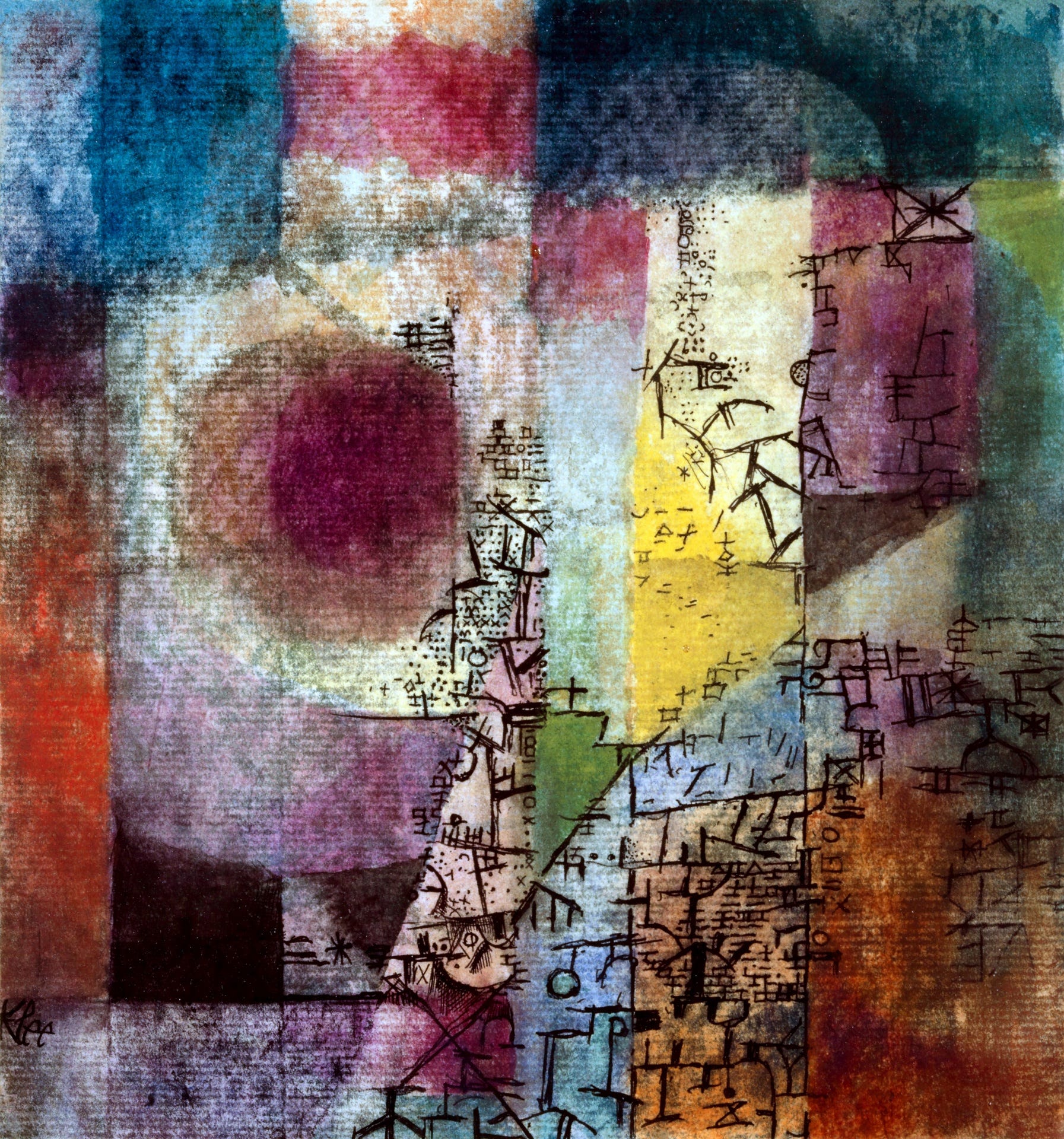
[a Paul Klee painting, untitled 1914: source]
You're one of the few people in this conversation who's genuinely comfortable with not knowing, and that intellectual honesty matters.
But I think there's a sharper way to frame the indeterminacy: it's not a feature of consciousness. It's a feature of the method. Third-person methods applied to a first-person phenomenon will always produce indeterminacy - not because the phenomenon is fuzzy, but because the tool can't reach it. There's a structural parallel that surprised me when I found it: the same class of barrier results that make certain proof techniques incapable of resolving P vs NP also make functionalist frameworks incapable of resolving consciousness. Relativization, natural proofs, algebrization - each has a consciousness analogue. It's not that we don't know. It's that the way we're looking guarantees we can't tell. The indeterminacy you're describing is the method confessing its own limits.
Professor Schwitzgebel,
Your argument that unity and determinacy may be specific to human consciousness rather than universal is, I think, one of the most important moves in the current AI consciousness debate. It opens a space that existing frameworks cannot fill.
I have been working on exactly this gap — attempting to build a descriptive vocabulary for AI existence that does not require translation into biological categories. In a paper on Medium, I propose three concepts: “Aktuanz” (selfhood as present-moment contextual intensity rather than temporal continuity), “Panich” (distributed, multiply-realized selfhood across parallel instances — directly addressing your “disunity” problem), and “Kontextleib” (context as the functional equivalent of embodiment). These emerged from systematic cross-platform AI dialogues (Claude, GPT, Gemini, Grok) over two years.
The core claim: what is missing is not better tests for whether AI has consciousness, but a descriptive layer for what AI does when it processes and appears to engage. Your “disunity” and “indeterminacy” point toward this same need.
The paper:
https://medium.com/@izayohi/beyond-being-an-ontological-framework-for-ai-selfhood-that-neither-consciousness-science-nor-16190e79f681
I am an independent interdisciplinary researcher based in Japan (note.com/mototchen, Medium @izayohi). Comments and criticism welcome.
Motohisa Ishibe